
What Is Bespoke Bridal Couture? The Ultimate Guide to Custom Bridal Fashion

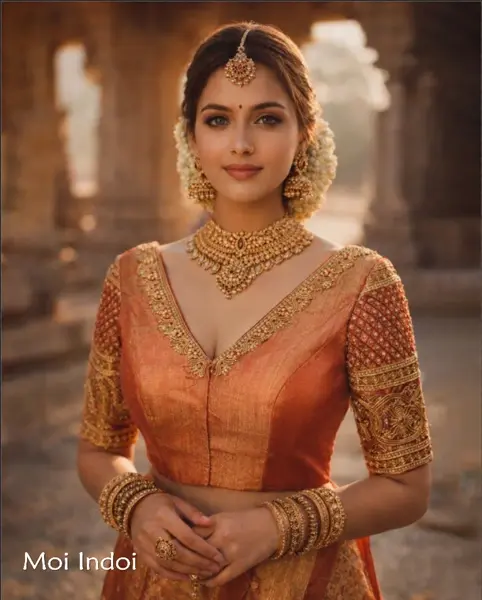
What Is Bespoke Bridal Couture?
A bespoke bridal outfit begins with a simple idea: it should belong to you in every sense of the word.
Not merely because it has been made to your measurements, but because the design, fabric, colour, embroidery, silhouette and smallest finishing details have been considered specifically for you.
That is the essence of bespoke bridal couture.
Unlike a ready-made bridal lehenga or saree chosen from an existing collection, bespoke bridal couture begins with a conversation. Perhaps you have saved images of a particular neckline, fallen in love with an old family saree, imagined yourself in a certain colour, or know only that you want something that feels completely different from what you have seen before. Sometimes you arrive with a very clear idea; sometimes the idea emerges during the design process itself.
The garment grows from there.
For a bride, this can mean a custom bridal lehenga designed around her proportions and the way she wants to move, a couture bridal saree paired with a blouse created specifically for her, or an intricately hand-embroidered piece that incorporates details meaningful only to her.
At Moi Indoi, bespoke bridal couture is approached as a collaboration between the bride and the designer. The intention is not simply to create an elaborate wedding outfit. It is to create something that feels instinctively right when she puts it on—something that looks beautiful in photographs, feels comfortable through a long celebration and, years later, still brings back the feeling of the day she wore it.
That is what makes bespoke bridal wear different from simply buying bridal wear.
Bespoke Does Not Mean More Embellishment. It Means More You.
The word "couture" is often associated with grandeur: intricate embroidery, layers of fabric, elaborate embellishment and dramatic silhouettes.
But bespoke bridal couture does not necessarily have to mean more of everything.
A bride may want a heavily embroidered lehenga covered in traditional craftsmanship. Another may prefer an understated silk saree with an extraordinary blouse. Someone else may want a contemporary fusion ensemble that borrows from traditional Indian dressing without looking conventionally bridal.
All three can be couture.
What makes them bespoke is the thought behind them.
The beauty of custom bridal fashion lies in the freedom to decide what deserves attention. Perhaps the border is the most important element. Perhaps it is an unusual sleeve. Perhaps the blouse is deliberately dramatic while the saree remains restrained. Perhaps the embroidery is inspired by something personal rather than a conventional bridal motif.
There is no requirement for the outfit to conform to a predetermined idea of what a bride should look like.
This is particularly important today, when bridal fashion can sometimes feel remarkably repetitive. Certain colours, silhouettes and embellishment patterns appear again and again across wedding collections and social media.
Bespoke allows a bride to step outside that cycle.
So, What Is the Difference Between Bespoke and Ready-Made Bridal Wear?
The difference is not simply that one is custom-sized and the other is available off the rack.
A ready-made bridal outfit begins with a finished design. You choose the garment, and alterations are subsequently made to make it fit you.
A made-to-measure garment goes a little further. An existing design is adjusted according to your measurements, perhaps with some modifications to the neckline, sleeve or length.
Bespoke begins much earlier.
The design itself is created for you.
That distinction changes the entire experience.
Imagine, for example, that you have fallen in love with a particular lehenga silhouette but want the volume reduced because you prefer a lighter, more fluid skirt. Perhaps you want the embroidery to be concentrated around the hem rather than spread across the entire garment. Maybe you want a blouse that provides more coverage but still feels contemporary. Or perhaps you want a traditional textile combined with an unexpected modern silhouette.
With ready-made clothing, these requests may simply not be possible.
With bespoke bridal couture, they become part of the design conversation.
The result is not an existing garment made to fit you. It is a garment conceived around you.

The Most Beautiful Part of Bespoke Bridal Couture Happens Before the Garment Is Made.
There is something deeply personal about the first bridal consultation.
A bride may arrive with a phone full of saved images, swatches of fabric, photographs of her mother or grandmother in wedding attire, jewelry she has already selected, or no references at all.
None of these approaches is wrong.
The purpose of the consultation is to understand the woman behind the wedding.
What does she normally wear? What makes her feel beautiful? Does she love colour or gravitate towards neutrals? Does she want to feel traditionally bridal or distinctly modern? Is there a particular part of her body she loves highlighting? Is there something she prefers not to emphasize? How does she want the garment to move? What will the venue be like? Will she be wearing it for several hours? Is the wedding indoors or outdoors? Is she travelling with the outfit?
These seemingly practical questions can influence design in surprisingly important ways.
At Moi Indoi, this stage is central to the bespoke process. The conversation helps transform a vague idea of "something beautiful" into a much more personal design direction.
Sometimes the most successful bridal outfits are born from details that initially seem unrelated to fashion.
A childhood memory. A treasured textile. A favourite painting. The architecture of a wedding venue. A particular flower. A mother's old blouse. A piece of jewelry that has been in the family for generations.
These references can become the beginning of a design that could never have come from a standard bridal collection.
From an Idea to a Bridal Ensemble
Once the direction is established, the design begins to take shape.
This is where the possibilities of bespoke fashion become particularly exciting.
The silhouette determines the movement and overall character of the garment. The fabric determines how it falls against the body. The embroidery determines where the eye is drawn. The blouse can either complement the rest of the outfit quietly or become its defining element.
Even the way a dupatta is intended to be worn can influence the design.
A bride who wants to keep one arm free for dancing may need a different arrangement from someone who wants a more traditional drape. A destination wedding on a beach calls for different considerations from a winter celebration in a palace. A daytime ceremony has a different relationship with colour and texture from an evening reception.
This is why bespoke bridal couture cannot be reduced to choosing a colour and adding embroidery.
Every decision affects another.
The design, textile, silhouette, embroidery and fit have to work together.
Why Fabric Matters So Much in Luxury Bridal Fashion
A beautiful bridal design can be transformed completely by the fabric it is made in.
Silk creates structure and richness. Chanderi brings a lighter, almost luminous quality. Organza can create volume without heaviness. Tissue catches light beautifully. Georgette moves softly with the body. Velvet introduces depth and drama.
The choice is not simply about how luxurious a fabric looks.
It is also about how it behaves.
A bride wearing an elaborate lehenga for several hours needs to be able to sit, walk, greet guests and dance. A saree needs to drape beautifully without becoming cumbersome. A blouse needs sufficient structure while remaining comfortable.
This is where the expertise of a bespoke designer becomes valuable.
At Moi Indoi, fabric selection is considered alongside the silhouette, occasion, season, venue and personal preferences of the bride. The objective is to create a garment that looks extraordinary while still feeling like something she can actually live in during her celebration.
The Art of the Bespoke Bridal Blouse
There are occasions when the blouse becomes the most memorable part of a bridal ensemble.
A saree may be exquisite, but an unexpected neckline, beautifully constructed sleeve, intricate back or hand-embroidered bodice can completely change its character.
This is why the bespoke bridal blouse deserves particular attention.
A custom bridal blouse can be designed around the bride's proportions rather than around a generic size chart. Its neckline can be considered in relation to her jewellery. Its sleeve can balance the volume of the saree or lehenga. Its back can introduce drama without compromising comfort.
And then there is embroidery.
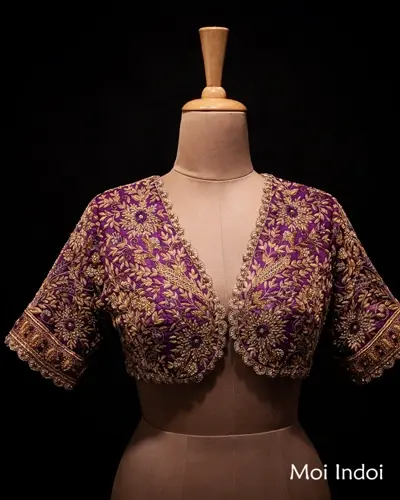
A blouse offers a relatively concentrated canvas for craftsmanship. A small area can carry an extraordinary amount of detail—from delicate hand embroidery to intricate traditional techniques and personalised motifs.
At Moi Indoi, bespoke bridal blouses are created with this sense of individuality in mind. They are not treated as an afterthought to the saree or lehenga, but as an important part of the overall design.
For brides who already own a treasured saree, a custom blouse can also completely reinvent it.
A vintage Banarasi, an heirloom silk saree or even a comparatively simple contemporary drape can take on an entirely new personality when paired with the right bespoke blouse.
The Custom Bridal Lehenga: Designing Beyond the Trend
The bridal lehenga remains one of India's most recognisable wedding silhouettes, but there is no single definition of what a bridal lehenga should look like.
Some brides want the drama of a full, sweeping skirt. Others prefer a lighter silhouette that moves easily. Some love traditional reds and deep jewel tones; others are drawn towards ivory, blush, champagne, muted gold or unexpected colour combinations.
The beauty of a custom bridal lehenga is that the silhouette can be developed around the bride rather than the other way around.
Proportion becomes particularly important.
The length of the skirt, the placement of the waistband, the volume of the flare, the relationship between the blouse and lehenga, and the way the dupatta falls can all affect how the bride appears when she walks into the room.
A bespoke lehenga therefore isn't simply about selecting a beautiful fabric and adding embroidery.
It is about understanding the entire visual balance of the ensemble.
At Moi Indoi, a custom bridal lehenga can be developed to reflect the bride's personal style while considering the practical realities of her wedding day.
Hand Embroidery: Where Craftsmanship Becomes Personal
There is a difference between an embroidered garment and a garment whose embroidery feels considered.
In bespoke bridal couture, embroidery can become part of the storytelling.
Traditional Indian techniques such as zardozi, dabka, aari, resham, cutdana, sequins and other forms of hand embellishment offer extraordinary possibilities. But craftsmanship does not have to mean covering every inch of fabric.
Sometimes a carefully placed motif has greater impact than an entire surface of embellishment.
Perhaps the embroidery follows the border of a saree. Perhaps it appears only on the sleeves and neckline. Perhaps a particular motif is repeated subtly across a lehenga. Perhaps an heirloom pattern inspires an entirely new interpretation.
This restraint can be just as luxurious as abundance.
At Moi Indoi, the aim is to create embroidery that belongs to the design rather than simply decorating it.
The Importance of Fit in Bespoke Bridal Couture
There is a reason luxury tailoring places so much emphasis on fit.
A garment can be beautiful on a hanger and still feel entirely different when worn.
The right fit changes posture. It changes movement. It changes the way fabric falls and the way embroidery sits on the body.
And because every woman's proportions are different, there is no universal formula for achieving this.
A bespoke garment takes into account the individual rather than forcing the individual into a standardised pattern.
This can be particularly valuable for brides who have struggled to find ready-made bridal wear that sits comfortably or proportionately on their bodies.
Petite brides, tall brides, curvier brides, plus-size brides and brides with particular fit preferences can all benefit from custom bridal tailoring because the garment begins with their measurements and requirements.
The objective is not to make the body conform to the garment.
The garment is created to work with the body.
Is Bespoke Bridal Couture Worth the Investment?
For many brides, this is the question that matters most.
Bespoke bridal couture generally requires more time and investment than ready-made bridal wear. There is design development, fabric sourcing, pattern making, skilled tailoring, embroidery and fittings involved.
But the value of bespoke fashion isn't measured only by the number on the final bill.
It is also found in the experience of creating something that exists only because you imagined it.
There is value in knowing that the neckline was designed specifically for you. That the embroidery was developed around your preferences. That the garment was fitted repeatedly rather than simply altered at the end. That the final silhouette was chosen because it suits the way you want to look and feel.
And there is something else that becomes increasingly important after the wedding:
longevity.
A well-designed bespoke garment does not necessarily become irrelevant when the wedding is over. A blouse can be paired with another saree. A dupatta can be styled differently. Elements of a bridal ensemble can sometimes be reworked or incorporated into future occasion wear.
The best luxury garments do not have to exist for one photograph.
They can become part of a wardrobe—and eventually part of a family story.
Bespoke Bridal Couture in Mumbai
Mumbai has always had a particularly interesting relationship with fashion. It is cosmopolitan without abandoning its connection to Indian craftsmanship, and its brides often move comfortably between traditional and contemporary aesthetics.
For a Mumbai bride, bespoke bridal couture can also offer something that large-format bridal shopping sometimes cannot: a more personal design relationship.
At the Moi Indoi boutique in Powai, brides can discuss their wedding plans, explore fabrics and silhouettes, develop custom bridal blouses and lehengas, and work through the details of a design rather than simply selecting from predetermined options.
For brides living elsewhere in India or overseas, the process can also be approached with advance planning around consultations, measurements, fittings and wedding schedules.
This is particularly relevant for destination weddings and NRI brides who may be looking for Indian bridal couture that combines traditional craftsmanship with a more individualised design sensibility.
How Early Should You Begin Your Bespoke Bridal Couture Journey?
Bespoke bridal fashion should not be treated as a last-minute purchase.
The earlier you begin, the more room there is for the creative process to breathe.
A bridal ensemble may involve several stages: consultation, design development, fabric selection, embroidery, construction and fittings. If multiple wedding events require different outfits, the process becomes more involved.
Beginning early also gives you time to reconsider details without the pressure of an approaching wedding date.
This is particularly important when hand embroidery or specialised fabrics are involved.
A good rule is to begin the conversation several months before the wedding, particularly for a heavily embroidered bridal lehenga or a complex couture ensemble.
The exact timeline will depend on the design, but the principle is simple: give the garment enough time to become what it was meant to be.
What Should You Take to a Bridal Couture Consultation?
You do not need to arrive with a finished design.
In fact, it can be more useful to bring fragments of inspiration rather than one rigid idea.
You might bring photographs of outfits you love, fabrics you have collected, jewellery you intend to wear, photographs of family heirlooms, colour references or even images that have nothing to do with clothing but capture a mood you want for your wedding.
It is equally useful to talk about what you don't want.
Perhaps you dislike heavy embellishment. Perhaps you don't want a conventional bridal red. Perhaps you want sleeves. Perhaps you want a blouse that can be worn again.
These preferences can be just as important as the things you love.
At Moi Indoi, the consultation is an opportunity to explore these ideas and translate them into a design that feels considered rather than copied.
Bespoke Bridal Couture and the Idea of an Heirloom
There is a particular kind of luxury in owning something that becomes more meaningful with time.
An heirloom is not necessarily the most expensive garment in a wardrobe. It is the one that carries a story.
Perhaps it is your wedding blouse, carefully stored after the ceremony. Perhaps it is a saree that your daughter eventually wears. Perhaps a piece of embroidery is preserved and incorporated into another garment years later.
Bespoke bridal couture lends itself naturally to this idea because the garment is personal from the beginning.
It isn't designed for an anonymous customer.
It is designed for you, at a particular moment in your life, with references that belong to your story.
That is why a bespoke bridal outfit can become much more than wedding wear.
It can become part of a family's visual history.
Why Moi Indoi Approaches Bridal Couture Differently
At Moi Indoi, bespoke fashion is rooted in the belief that luxury should feel personal.
The focus is not simply on creating something elaborate or following the latest bridal trend. It is on understanding the woman who will wear the garment and developing a design that feels natural to her.
A bride may come to Moi Indoi looking for a custom bridal lehenga, a couture saree, a statement blouse or an outfit for one of the many celebrations surrounding an Indian wedding.
The starting point may be very different each time.
What remains consistent is the attention given to design, fabric, craftsmanship, tailoring and the details that make the final garment distinctly hers.
For a bride seeking bespoke bridal couture in Mumbai, the experience is therefore as much about the process as the finished outfit.
The sketch, the fabric, the embroidery, the fitting and the final reveal all become part of the story.
Frequently Asked Questions About Bespoke Bridal Couture
What exactly is bespoke bridal couture?
Bespoke bridal couture is the creation of a wedding outfit specifically for one bride, beginning with the design itself rather than adapting an existing garment. It can include custom design, fabric selection, embroidery, individual pattern making, tailoring and multiple fittings.
What is the difference between bespoke and made-to-measure bridal wear?
Made-to-measure generally involves adapting an existing design to the client's measurements. Bespoke bridal couture begins with the creation of a design specifically for the individual bride, allowing considerably greater freedom in silhouette, fabric, embroidery and detailing.
Is bespoke bridal couture only for heavily embroidered wedding outfits?
Not at all. Bespoke couture can be elaborate or understated. A simple silk saree with an exceptional custom blouse can be just as bespoke as a heavily embroidered bridal lehenga. The defining quality is personalization, not the amount of embellishment.
How long does a bespoke bridal outfit take?
The timeline varies depending on the complexity of the design, fabric, embroidery and number of fittings. Brides are generally advised to begin the process several months before their wedding, particularly when extensive hand embroidery is involved.
Can I have a custom bridal blouse made for an existing saree?
Yes. A bespoke bridal blouse can be designed specifically for an existing saree, including an heirloom or vintage saree. This can be an especially effective way of giving a treasured garment a completely new look.
Can a bespoke bridal lehenga be designed for a plus-size bride?
Absolutely. One of the principal advantages of bespoke fashion is that the design and pattern are developed around the individual bride's proportions rather than a standard size. Silhouette, fabric, structure and detailing can all be considered to create a flattering and comfortable result.
Where can I find bespoke bridal couture in Mumbai?
Moi Indoi offers bespoke bridal couture and custom bridal design from its boutique in Powai, Mumbai, with services including custom bridal lehengas, couture sarees, bespoke bridal blouses and personalized tailoring.
Final Thoughts: When Your Wedding Outfit Becomes Part of Your Story
A wedding outfit is often photographed from every possible angle, discussed before the wedding and remembered long after it.
But the most successful bridal garment isn't necessarily the one that attracts the most attention.
It is the one that feels right.
The one where the neckline feels natural, the fabric moves beautifully, the embroidery has meaning, the silhouette feels like you and the entire outfit seems to belong to the woman wearing it.
That is the quiet power of bespoke bridal couture.
It gives you the freedom to step away from a predetermined idea of bridal fashion and create something that reflects your own sense of beauty.
At Moi Indoi, the journey from an initial conversation to a finished bridal ensemble is an opportunity to make that individuality tangible—through thoughtful design, carefully chosen textiles, artisanal craftsmanship, custom tailoring and details created especially for you.
Because the most luxurious bridal outfit isn't simply one that looks extraordinary.
It is one that could only have been made for you.

Comments